

At Bure Valley, we believe that a strong English curriculum should develop children’s love of reading, writing, speaking and listening, as well as preparing pupils for the next stage of their education. Our children have a wide range of opportunities to develop these skills for a variety of purposes and contexts across the curriculum.
We are passionate about reading and have books at the heart of our curriculum. We strive to inspire a lifelong love of reading for pupils through trips, visitors, book fairs, national competitions, our school reading challenges and other special reading events. Through our curriculum, pupils are exposed to a range of carefully chosen texts from a range of genres and styles. These texts are used to inspire writing, analyse the writer’s craft, develop comprehension, expose pupils to new vocabulary and support a range of other skills key to success in English.
We have a nurturing culture where children take pride in their writing. Pupils write clearly and accurately, learning how they can adapt their style for a range of contexts, purposes and audiences. Our pupils develop a confident understanding of punctuation and grammar in order to use and manipulate language for different purposes. This gives pupils the power to make their writing clear, impactful and dynamic. We understand the importance of ensuring children have secure literacy skills, and believe this is crucial to a high-quality education that gives our children the tools they need to thrive within society.
Core Threads
Reading: Phonetic knowledge, Fluency and Decoding, Comprehension and Inference
Writing: Grammatical Correctness, Writing for Purpose, Applied Vocabulary
Curriculum Drivers in English
The following curriculum drivers, alongside our Framework for Excellence and values, underpin our curriculum philosophy and the implementation of our curriculum intent:
- To promote effective communication, vocabulary development and a love of reading
- To be inclusive and meet the needs of all children
- To provide a wide range of experiences and opportunities beyond the requirements of the national curriculum
- To develop the whole child and prepare them for the next phase of their education
- To encourage mentally healthy and emotionally literate children
To promote effective communication, vocabulary development and a love of reading
Reading, writing and vocabulary permeate the English curriculum at Bure Valley. Pupils regularly have opportunities for drama, reading aloud and working in groups in most English units. Drama techniques like hot-seating, story pegging and conscience alley are used frequently. Vocabulary is very important to the teaching of English. It is explicitly taught in our Guided Reading sessions. As a school, we have done significant professional development on developing pupils’ vocabulary, using Word Aware and Reading Reconsidered as key texts, as well as other research. A love of reading is promoted time and time again at Bure Valley. Our entire school is centred around our incredible library and we regularly welcome authors and illustrators to visit. We have a school reading challenge which is very popular and culminates in pupils visiting the local Norfolk Children’s Book Centre to pick books for our ever-expanding selection. We regularly restock our library with the latest short-liste and winners of the UKLA book awards. Every class has a class reading book which is read by the teacher to pupils in short sessions regularly throughout every week. Our school text selection criteria helps to ensure that pupils are accessing valuable texts in these sessions. The subject leader also leads termly assemblies on new books being added to the school library shelves.
To be inclusive and meet the needs of all children
The school SENDCO and English subject leader meet regularly to discuss provision and intervention, especially for those pupils who are behind in reading, where specific attention is paid. SEN pupils will have specific LSP targets for English where that is an area of focus. Our school text selection criteria helps staff to identify where texts represent pupils best and where they do not. We recently undertook a major survey of the texts used in school and identified where authors and characters of varying ethnic, religious and gender backgrounds were represented (available to review on request). This identified a lack of representation of female authors, and POC authors and characters. We have since taken steps to improve this, including a wider range of texts in our school library and curriculum to represent pupils of all backgrounds. The genres of writing taught in school are also diverse and powerful – pupils spend significant time learning how to write formally, persuasively and for effect. This is especially important to us, as it is these styles of writing which will best prepare pupils for later life. When assessing pupils’ writing, each class teacher has time with the subject leader during each term to discuss any outliers, or those who may be requiring additional support. Our writing assessment criteria makes allowances for pupils who may not meet every objective as needed by a secure-fit framework.
To provide a wide range of experiences and opportunities beyond the requirements of the national curriculum
The English national curriculum offers little in regards to which genres of text and writing should be taught, however we have a rigorous and broad curriculum which include a range of interesting and exceptional genres rarely experienced by a more traditional curriculum, for example, writing reviews of pizza or sports commentaries. By offering this broad experience, pupils can find and develop in their own areas of strength. Writing in English is frequently, but not always, linked to other curriculum areas. Pupils will often use experiences outside of the classroom to inform writing, such as recounting a trip or science experiment. All subject leaders have produced documentation which clearly shows these to English in the wider curriculum.
To develop the whole child and prepare them for the next phase of their education
As previously mentioned, we believe a focus on powerful genres such as more formal and persuasive writing opportunities, support pupils in learning skills that will support them into high school and further. However, as some of these genres are repeated, it is key that their progression be clear so that pupils are not simply repeating previous learning. Staff compared and altered planning to create progression documents for each of these genres which are repeated to ensure pupils are pushed to progress. The English Subject leader has regular contact with the English leader at Aylsham High School and discusses the needs of cohorts. We have worked on projects across this phase, including much work on comparative judgements.
To encourage mentally healthy and emotionally literate children
Much of writing in English involves empathy and exploring life through the experience of others. Throughout our units, pupils have to articulate and explore the lives and feelings of individuals. This may be thinking about how to convince Mr Olney not to extend the school day, instruct a reader on how to build a Stone Age trap, or describe how Scrooge feels as he looks through the window of Bob Cratchit’s house. These skills are embedded in the curriculum and require skills of articulation and empathy towards others.
Phonics and Early Reading
At Bure Valley School we recognise the need to continue to support some pupils with learning grapheme-phoneme correspondences (GPCs). We help our pupil’s progress from simple sounds to developing more complex knowledge and skills.
As part of our transition process, we find out from infant feeder schools which pupils have failed their phonics checks and who will require ongoing support and intervention. However, all pupils are assessed using STAR Reading assessments on entry to the school. This includes in-year transfers.
Using pupil’s Normed Referenced Standardised Scores (NRSS), reading age data and Zone of Proximal Development (ZPD) scores, class teachers select interventions to match pupils’ needs based on existing knowledge. Pupils requiring additional phonics support, receive targeted intervention on a 1:1 or small group basis. This is overseen by our English lead and SENCO.
For pupils who are below the Star Reading test standard, are required to complete a Star Early Literacy Assessment. These pupils may also be asked to take a complete Comprehensive Test of Phonological Processing (CTOPP-2) alongside our SENCO. If appropriate pupils will be added to our SEN register and will be given a Learning Support Plan (LSP).
Intervention activities completed outside of the classroom are often prescribed by the scheme being followed. This involves a separate assessment to find appropriate starting points. Ideally, no pupil will receive more than one reading intervention at any one time.
Read Write Inc. Fast Track: this intervention follows straight on from our KS1 feeder school. Pupils have fully decodable books from the scheme to take home. Sessions teach phonics in a 1:1 or paired group. This intervention is deemed appropriate for pupils who need to continue their journey of phonological awareness, phoneme/grapheme knowledge and blending/segmenting skills.
Project X-Code: this intervention is for pupils who are already armed with phonological knowledge and blending skills, yet require structured opportunities to rehearse their skills. Pupils revise phonics sounds, share levelled books and complete comprehension activities around the text they are reading. This intervention can be completed in groups.
Toe by Toe: this intervention is precision teaching pupils for whom traditional phonics approaches have not worked. This intervention is aimed at pupils who have already had significant support with phonics skills (ideally from Read Write Inc.). Toe by Toe uses engineered progress to slowly build up pupil’s knowledge of sounds and graphemes. It is completed daily in five minute, 1:1 sessions.
Morph Mastery: this intervention is an etymology based intervention which teaches children how words are built and made of units, similar to our spelling lessons in the main curriculum. This intervention is ideal for dyslexic pupils who have not made progress with traditional phonics over a number of years.
Where appropriate we seek support from the Dyslexia Outreach Service and utilise assisted technology to support reading development and progress.
Reading
The National Curriculum aims to ensure that all pupils:
- Read easily, fluently and with good understanding
- Develop the habit of reading widely and often, for both pleasure and information
- Acquire a wide vocabulary, an understanding of grammar and knowledge of linguistic conventions for reading, writing and spoken language
- Appreciate our rich and varied literary heritage
At Bure Valley, we put reading at the heart of learning to ensure that children have the opportunity to use reading for a range of purposes and develop a love of reading. We have an extensive, well-stocked and ever-growing school library. All classes have dedicated time for sharing books and for reading – independently, and together. We also have a reading shed and reading garden on our playground so children have the opportunity to read their favourite books at break and lunchtimes.
We have a systematic system of teaching reading; where early reading books are carefully matched to children’s phonetic knowledge as children progress with their reading they move on to the Accelerated Reader system.
In key stage two, we use the Accelerated Reader system to enable children to choose appropriate level books to read. Children log on to the Accelerated Reader system at home and at school to take regular quizzes about the books they have read.
Children are given time to read these books every day at school and are also encouraged to read regularly at home as a part of homework. Reading widely is celebrated every week in our celebration assembly, with Bookworm Reading Awards being given out to those pupils who have completed tasks from our school reading challenge.
Guided Reading
Guided reading is completed in whole classes, who share one text together. We purchase class-sets of novels so that all pupils have access to the material being read. Pupils will then read aloud around the room, as well as tackle passages independently. This is then followed by a comprehension task. Vocabulary is also taught through guided reading and teachers will often pre-teach vocabulary before it appears in the text.
As well as whole texts being used in guided reading sessions, staff also use one-off comprehension activities based on shorter texts. These sorts of tasks better prepare pupils for the rigour of reading comprehension assessments and can allow for more focussed skill development, where questions may focus solely on one specific area, for example inference.
To develop comprehension skills, we use The Literacy Shed Reading Vipers. Key Stage 2 children have 3 guided reading lessons a week where they focus on a particular reading skill.
We work closely with parents and offer opportunities for parents to come into school and share a book with their child. We also run various reading meetings for parents to find out about how we teach reading at Bure Valley, and how they can support reading at home.
Reading Challenge
At Bure Valley, we also have our Bookworm Reading Challenge.
Children choose a book that is new to them, and which meets one of the ‘Book Choice’ criteria (in the files to the right and in pupil planners). Once they have read it, they must complete a response task of their choosing. There are many combinations, such as reading a book that looks old then redesigning the cover, or reading a book set in the future then writing a letter to the author!
There are three levels of certificate:
- Bronze – reading three new books and completing three tasks.
- Silver – reading eight new books and completing eight tasks.
- Gold – reading fifteen new books and completing fifteen tasks.
Silver and Gold achievers also receive a corresponding bookworm badge and get the opportunity to choose and purchase new books for the school library at the end of the year.
The challenge has little focus on page quantities or book length, but rather focuses on reading widely. This encourages readers of all ages and abilities to take part. By having criteria for books that count towards the challenge, this encourages children to find new and different books to their normal ‘safe’ choices. Of course, children are still free to select and read whatever they choose, and the challenge is not compulsory.
The tasks not only serve to confirm that children have read the titles they claim to, but also aim to embed a habit of discussing and reflecting upon what they have read.
BVS Reading Challenge Book Choices and Tasks
Writing
We have a well-developed and organised curriculum that has been honed and improved over multiple years. Most of our units of work are linked to key texts which stimulate writing, offer context for activities, vocabulary development and deepen children’s understanding across the wider curriculum. Our grammar and punctuation teaching is embedded within these English units as we believe that children develop a stronger understanding when they are taught in context. Many of our units began life as prepared planning for other providers, but have been altered and improved over many years to offer the best possible experience for our learners. We have a general sequence for planning a unit of English work that ensures children have the opportunity to get to know a text well and develop grammatical skills in context.
This generally involves:
- exploration of a high-quality text which models the skills to be taught and emulated
- appreciating and analysing the decisions made by an author for effect
- supported tasks which allow pupils to rehearse their new skills
- opportunities to use new learning in independent writing
- further opportunities to edit and improve writing once it is completed
Children develop an understanding of different text types and writing for different purposes following this progression.
Writing Non-Negotiables
Across the curriculum, we expect pupils working at the expected standard to ensure their writing is of a high standard. This way, we support pupils in realising that clear communication is important no matter the context, and not just in English lessons. Each year group has a carefully chosen number of non-negotiables that pupils must strive to achieve in every piece of written work. If pupils are repeatedly not achieving these, then teachers may begin to consider support that may need to be put in place.
Handwriting
At Bure Valley, we follow the LetterJoin scheme to support handwriting lessons. You can find out more about the scheme here.
The school, alongside John of Gaunt Infant and Nursery School, started the scheme in September 2024, with a view to improve overtime the quality of handwriting and presentation across both schools.
Letter-join’s scheme of work supports our aim for pupils to develop fluent and legible handwriting style over time, to ensure they reach the standard expected at the end of Key Stage 2.
Key Stage 1:
By the time pupils join us from KS1 feeder schools, they should be able to correctly form printed letters, capital letters, numbers and punctuation.
Pupils should also be able to produce neater handwriting with consistent spacing and letter sizes as well as developing ‘speedy handwriting’.
As pupils’ confidence, fine and gross motor skills develop and they learn to sit correctly for handwriting using a tripod grip they should begin to move from print to cursive handwriting. Practising letter formation and how to join their handwriting.
Key Stage 2
As pupils build on KS1 skills, they begin to write passages of text neatly and speedily. Letter-join supports pupils to acquire a feel for neatness and quality in their final handwritten work. With practice pupils develop writing stamina and will cover all the criteria necessary by the end of Y6 to reach the standards set out in the National Curriculum for handwriting.
Key Stage 2 Modules
Module 4: Year 3
The handwriting lessons in Module 4 are presented in sets of two lessons per week and are designed to improve legibility, consistency and quality of handwriting. It is targeted at Year 3 children in lower KS2 where pupils should be using joined handwriting throughout their independent writing.
The worksheets for this module cover a variety of curriculum topics: Dictation, double letters, number vocabulary, palindromes, tongue twisters, MFL (French and Spanish), onomatopoeia, simile, WOW words and spellings.
Module 5: Year 4
Module 5 focuses on using handwriting practice to support other subjects in the curriculum and, at the same time, builds on fluency and consistency. This module aims to promote meaningful links with other subjects such as English, maths, science, geography, French and Spanish. Making such links enables children to apply the skills they are learning in context and also provides depth to the curriculum. Learners will continue to develop legible handwriting through the regular practice offered in this module’s lessons.
Module 6: Year 5
Module 6 continues to build on combining fluent handwriting with other subjects across the curriculum. In this module, learners will have plenty of opportunity to develop the stamina and skills to write at length, with accurate spelling and punctuation. With Letter-join’s wide range of resources, they will be able to work towards producing consistently neat and well-presented handwriting in all curriculum subjects. By the end of this module, children should be producing cursive writing automatically, enabling them to focus on the content of their work rather than the process of writing.
Module 7: Year 6
The aim of Module 7 is to ensure that handwriting is neatly presented and clear in readiness for KS2 SATs and is the expected standard of handwriting for Year 6. Learners will consolidate the stamina and skills required to write at length, with accurate spelling and punctuation. They will develop more of a personal handwriting style as they write with automaticity and will learn to write at different speeds with different attention to neatness, depending on the task.
Promoting speedy, fluent writing continues to be a strong feature in Module 7. Challenging dictation exercises will refine pupils’ revising and checking skills as well as boosting their handwriting speed, stamina and fluency. A range of curriculum-based worksheets will give pupils the opportunity to practise writing at length.
By the end of this module, children should be able to adapt their handwriting for a range of tasks and purposes and to create different effects. They should be clear about what standard of handwriting is appropriate for a particular task, for example, quick notes, a final handwritten version, an un-joined style or capital letters. All of these writing styles are covered in this module.
Speaking and Listening
Opportunities for speaking and listening are built-in across our Curriculum, ensuring there are opportunities for discussions in pairs, groups and as a class. As a part of a teaching sequence, teachers may also facilitate drama activities such as opportunities to hot seat, enact scenes, or set up a conscience alley.
Children also have opportunities for learning and reciting pieces to the class and the wider school, such as in class assemblies, parent performance or other services.
Children are encouraged to explain their thoughts and ideas on a daily basis and develop an understanding of what makes a good listener, across the curriculum.
We have a clear assessment schedule to monitor children’s progress in reading, writing and phonics.
At Bure Valley, our Reading curriculum impact is assessed daily through formative assessment practices and termly using PIRA standardised tests, Hodder Salford Reading and GL Assessment Single Word Spelling Test tests.
For writing, we use a range of additional tools for assessment. Teacher’s make multiple assessments termly using our school Writing Assessment Frameworks. These judgements are moderated internally throughout the year. We have collated our own set of example collections to support these frameworks, similar to the Standards Testing Agencie’s collections which demonstrate the end of KS2 standards. We also participate in No More Marking’s national Assessing Primary Writing programme which uses comparative judgements to provide us with a detailed understanding of our pupil’s writing. These assessments are nationally standardised, with insights based on over half a million pieces of writing.
Teachers triangulate evidence to inform end of year teacher assessment judgements in reading, writing and SPaG and these are recorded on SIMs (our school management information system).
High quality writing is frequently published for display and for end of year pupil exhibitions. Examples of work are kept to enable children to see their own progress and that of others.
We use a local authority trained moderator to run book-looks and writing moderation sessions with staff. This helps us to identify areas of success and areas requiring further development. Our year six staff engage termly with the LA assessment team to ensure they are up to date with all training in regards to meeting end-of-key-stage assessment requirements.
A robust monitoring schedule gives leaders the opportunity to look at children’s work, read with children and monitor phonics assessments. Pupil voice and observations of children show that children talk enthusiastically about reading and writing and understand the importance of the subject. Children love to talk about books and have opportunities to recommend reads for their friends. More than 250 reading challenge certificates have been given out each year since its inception.
All aspects of English are an integral part of the curriculum, and skills learned in these lessons are used constantly in other areas of learning.
Useful links
Promoting Reading
• Model reading
• Central to all subjects
• Inspiring library
• Presence and use of books
• Staff are reading advocates
Writing Links to Reading
• Vocabulary focus before writing
• Sentence stacking
• Shared writing
• Re-drafting
• Exemplifications
• Exposure to different genres
• Exposure to different texts
Core Knowledge
Within each English unit, we outline:
- the objectives we want pupils to meet
- the learning to be taught and revisited
- the key concepts we want pupils to retain and apply
- the vocabulary/spellings we want pupils to know and use correctly
We support this through a range of reflection and retrieval (R&R) activities that teachers can apply at their discretion. Some are generic and some are English specific:
- R&R Do Now’s – last year, last term, last unit, last week, last lesson
- Quizzes
- Reflective Learning Questions: exit ticket, multiple choice, can you still…, etc.
- Knowledge Flashcards
- Mind Maps
- Presentations – Speak Like an Expert
- Write a ‘Power Paragraph’ about what you know
- Show your Partner
- Daily Reading
- Tricky Word Lists
- Summarising, headlining and linking
- Genre recap
- Recall Bingo
- Challenge Grids
- Home Learning Links, Resources and homework
- Lesson Recaps/Revisits
Spelling is a priority. We recognise that it is an important part of clear and concise communication, not only within the curriculum, but in further life. We have developed our spelling curriculum to address the needs of our pupils and begin a shift in the way children think about and learn about spelling. Using research in the field and support from the local authority, we have identified the key values that our spelling curriculum and approach should reflect.
We want all of our pupils to:
- be able to make ‘best bets’ when spelling unfamiliar words using a range of spelling ‘rules’ to guide their choices
- have some etymological appreciation for how words change over time
- have a strong morphological understanding of how words are assembled
- have a range of subject-specific vocabulary with which to discuss words
- participate in activities which support rehearsal, muscle-memory development and word sight-recognition
- practice spellings which are appropriate to their own personal spelling level
- repeatedly revisit taught content across multiple years
We have not yet identified a commercially-available scheme that fully supports the above elements of spelling, so we follow our own programme. Our spelling scheme is based around the non-statutory National Curriculum guidance, with some supplementary content added.
Spelling lessons involve pupils engaging in tasks such as card sorts and games, to identify words which fit rules and their exceptions. Teachers have ready access to a range of words which exemplify the application of the taught rule, which includes any words from the KS2 Statutory Word List which may have the rule applied to them.
This curriculum is taught to all pupils, and each year features repeated objectives from previous year groups’ curricula. Key subject-specific vocabulary, such as ‘long vowel sounds’ and ‘affixes’ is revised at the start of every year.
An overview of our Spelling Curriculum objectives can be found here.
Spelling Frame
Spelling Frame is currently being used in school as an intervention workshop for selected pupils. However, the school is trialling its use with a view to rolling it out across the school to support our wider spelling curriculum and teaching.
Knowing how to correctly pronounce words is important when learning how to spell. Within the Spelling Frame, every word is read aloud and broken into syllables and these too are read aloud. Every word is also provided in a sentence, and every sentence read aloud, so that children also learn the meanings of the words.
Spelling Frame provides pupils with access to over 9500 spellings, word lists, games and activities. Pupils earn ‘spelling points’ by playing spelling games and activities. Spelling Frame allows pupils to track spelling scores over time and can provide personalised spelling lists, showing ‘tricky words’ that pupils may have got wrong for separate practice. Teachers can differentiate word lists for pupils or groups and track their progress.
The impact of our spelling teaching and learning can be seen in children’s attitudes to spelling lessons and their independent spelling work in class. Children enjoy being given the opportunity to practise their spellings using a variety of different strategies and although spelling can be a difficulty for some children, ensuring they feel supported and well equipped with strategies to assist them.
Monitoring of spelling lessons and pupil’s books demonstrate consistency in approaches and pupils articulate well the different ways they can practise their spellings or are helped in the classroom with spelling.
As part of Y6 SATs tests, children’s spelling knowledge is tested within the grammar and punctuation tests. We also monitor spelling attainment through Rising Stars GAPs standardised tests (age SS and spelling score) and specific intervention outcomes for pupils in receipt of a focussed intervention.
Monitoring and evaluation processes allow teachers to spot who is struggling and who should be considered for additional support.
Useful Links
Within each English/Spelling unit, we outline:
- the objectives we want pupils to meet
- new learning and learning to be revisited
- the knowledge we want pupils to retain and apply
- the vocabulary we want pupils to know and use correctly
We support this through a range of reflection and retrieval (R&R) activities that teachers can apply at their discretion. Some are generic and some are spelling specific:
- Pupils are encouraged to practice speling rules out of school and to practice spellings from the National Curriculum words list
- R&R Do Now’s – last year, last term, last unit, last week, last lesson
- GPC – grapheme, phoneme correspondence
- Quizzes
- Reflective Learning Questions: exit ticket, multiple choice, can you still…, etc.
- Spelling Flashcards
- Mind Maps
- Repeated spelling/handwriting practice
- Write a ‘Power Paragraph’ about what you know about a spelling rule
- Spelling lists, statutory words lists, common exception word lists
- Spelling Bees
- Spelling Bingo/Dominoes
- Challenge Grids
- Key vocab lists (tier 2 and tier 3)
- Home Learning Links and Resources
- Lesson Recaps/Revisits
At Bure Valley School, we recognise the importance of mathematics in each child’s everyday life and as an essential tool in equipping children with the skills for the future. It is a skill that is used on a daily basis and it therefore forms part of our broad and balanced curriculum. We endeavour to ensure that children develop an enjoyment and enthusiasm for maths that will stay with them throughout their lives.
We believe that all children are capable of learning and enjoying mathematics at a deep level. Our aim is to develop a positive culture of deep understanding, confidence and competence in maths that produces strong, secure learning. As a school, we recognise that the key to unlocking the potential in our children is through the development of basic mathematical skills and the understanding of mathematical concepts.
We aim to sustain and develop in all children:
- confidence, understanding and enjoyment in mathematics;
- awareness of relationship and pattern, and how these can bring about a clearer understanding of a situation;
- the ability to work systematically where the task requires a careful accurate approach, as well as the ability to show imagination, initiative and flexibility when appropriate;
- a strong understanding of number which enables children to have a strong ‘number sense’
- the fluency of number and understanding of key mathematical concepts
- the ability to reason and problem solve in a range of mathematical contexts
- the ability to recall information from long term memory and apply to varied situations
- to recall factual information to complete mental and written methods
The National Curriculum for mathematics aims to ensure that all pupils:
- become fluent in the fundamentals of mathematics, including through varied and frequent practice with increasingly complex problems over time, so that pupils have conceptual understanding and are able to recall and apply their knowledge rapidly and accurately to problems
- can reason mathematically by following a line of enquiry, conjecturing relationships and generalisations, and developing an argument, justification or proof using mathematical language
- can solve problems by applying their mathematics to a variety of routine and non-routine problems with increasing sophistication, including breaking down problems into a series of simpler steps and persevering in seeking solutions.
As a junior school we are aware of the expected standard in mathematics at the end of key stage one.
Expected Standard at the end of Lower KS2
The principal focus of mathematics teaching in lower key stage 2 is to ensure that pupils become increasingly fluent with whole numbers and the four operations, including number facts and the concept of place value. This should ensure that pupils develop efficient written and mental methods and perform calculations accurately with increasingly large whole numbers.
At this stage, pupils should develop their ability to solve a range of problems, including with simple fractions and decimal place value. Teaching should also ensure that pupils draw with increasing accuracy and develop mathematical reasoning so they can analyse shapes and their properties, and confidently describe the relationships between them. It should ensure that they can use measuring instruments with accuracy and make connections between measure and number.
By the end of year 4, pupils should know the multiplication facts up to and including the 12 multiplication table and show precision and fluency in their work.
Pupils should read and spell mathematical vocabulary correctly and confidently, using their growing word-reading knowledge and their knowledge of spelling. (DfE 2021)
Expected Standard at the end of upper KS2
The principal focus of mathematics teaching in upper key stage 2 is to ensure that pupils extend their understanding of the number system and place value to include larger integers. This should develop the connections that pupils make between multiplication and division with fractions, decimals, percentages and ratio.
At this stage, pupils should develop their ability to solve a wider range of problems, including increasingly complex properties of numbers and arithmetic, and problems demanding efficient written and mental methods of calculation. With this foundation in arithmetic, pupils are introduced to the language of algebra as a means for solving a variety of problems. Teaching in geometry and measures should consolidate and extend knowledge developed in number. Teaching should also ensure that pupils classify shapes with increasingly complex geometric properties and that they learn the vocabulary they need to describe them.
By the end of year 6, pupils should be fluent in written methods for all four operations, including long multiplication and division, and in working with fractions, decimals and percentages.
Pupils should read, spell and pronounce mathematical vocabulary correctly. DfE 2021)
Core Threads Maths: Fluency, Reasoning, Problem Solving
At Bure Valley School, in the teaching of mathematics we believe:
- Every child can succeed, regardless of background;
- That the teacher makes the difference;
- In being informed by evidence and research
- In working in partnership with other schools
We believe that great curriculum design and delivery leads to improved teaching and learner outcomes, which impacts positively on children’s life chances. We follow Mathematics Mastery, a programme from Ark Curriculum Plus, that is used by more than 300 primary schools across the UK to give non-specialist primary school teachers confidence in their approach to maths.
This maths programme is the only one in the UK to have had its impact shown by an Education Endowment Foundation trial.
Evidence shows that pupils make more progress when they have been equipped to master a subject by understanding its fundamental concepts in sufficient depth so that they can apply subject knowledge in unfamiliar contexts.
Our commitment is to provide high quality subject teaching, through curriculum collaboration and integrated professional development, in order to develop young people’s subject mastery.
The principles of Mathematics Mastery
The Mathematics Mastery approach is driven by teacher consultation and the latest cognitive and educational research. It is underpinned by the dimensions of depth – which together enable pupils to develop deep understanding of the subject.
The three principles of the dimensions of depth are:
Principle 1. Conceptual Understanding
Mathematics tasks are about constructing meaning and making sense of relationships. Learners deepen their understanding by representing concepts using objects, pictures, symbols and words.
Different representations stress and ignore different aspects of a concept and so moving between representations and making explicit links between them allows learners to construct a comprehensive conceptual framework that can be used as the foundation for future learning.
We use the content of the national curriculum as the starting point for our curriculum but this is expanded upon by making explicit the foundational knowledge that learners need to understand in order to access this.
Tasks are sequenced to help learners build a narrative through different topics. These topics are then sequenced in a logical progression that allows learners to establish connections and draw comparisons.
Multiple representations are carefully selected so that they are extendable within and between different areas of mathematics. Using these rich models encourages learners to develop different perspectives on a concept.
Principle 2: Language and Communication
Mathematical language strengthens conceptual understanding by enabling pupils to explain and reason. This must be carefully introduced and reinforced through frequent discussion to ensure it is meaningfully understood
The more learners use mathematical words the more they feel themselves to be mathematicians. Talk is an essential element of every lesson and time is dedicated to developing confidence with specific vocabulary as well as verbal reasoning.
The content of our curriculum carefully progresses in order to induct learners into the mathematical community. A large part of this community is confident use of the language, signs and symbols of mathematics. Verbal and non-verbal communication is part of every sequence of learning in the curriculum.
This often starts with more informal language initially, building up to formal and precise mathematical language.
Talk tasks are part of every lesson in the curriculum to help with this development.
Principle 3: Mathematical Thinking
By the time they reach school, all pupils have demonstrated a significant range of innate ways of thinking that can be harnessed in the classroom to develop mathematical thinking.
We must support pupils to develop mathematical ‘habits of mind’ – to be systematic, generalise and seek out patterns.
The creation of a conjecturing environment and considered use of questions and prompts are important elements of encouraging learners to think like mathematicians.
Our curriculum is designed to give learners the opportunities to think mathematically. Throughout the curriculum you will see tasks that require learners to specialise and generalise, to work systematically, to generate their own examples, to classify and to make conjectures.
This is aided by our prompts for thinking which help make these important parts of mathematics more explicit.
Maths Mastery lessons are broken into six parts.
- Do Now
The purpose of the Do Now task is to consolidate previous learning.
This could be:
- recapping on what was learnt the day before or a topic from a previous unit that is
- necessary for the current lesson. Do Now tasks should be independent work that the
- children do at their tables for about 5 minutes.
- New Learning
Introduces the main learning for the lesson, beginning by sharing the lesson’s key vocabulary with the pupils. This segment will require clear explanations and modelling of tasks to be completed throughout the lesson, especially the talk task. New learning lasts around 10 to 15 minutes.
- Talk Task/Let’s Explore
The main focus here is on the children working together in pairs or small groups and talking in full sentences about maths.
Developing pupils’ language is an important feature of the Mathematics Mastery approach, and taking turns and listening are important to children’s development. An alternative approach to this section is Let’s Explore – this is an opportunity for pupils to apply the skills they have learnt previously, by discussing and reasoning mathematically.
- Develop Learning
This mirrors the New Learning but aims to move the pupils’ learning on further and deepen their understanding. Learning could be developed by introducing different resources, adding a problem solving element, or encouraging further good language use following the Talk Task.
- Independent Task
Pupils practise their Develop Learning by working independently and demonstrating what they have understood and learnt.
- Plenary
The plenary is used to reflect on learning, gather evidence for assessments and plan for future learning. It should sum up what the children have learnt during the lesson, consolidating all learning, address any common misconceptions, and pose a question for the next lesson.
All classrooms have a number of mathematical, age appropriate resources.
Resources which are not used or required regularly are stored centrally and can be accessed easily by teachers. Each classroom has a maths display relating to the current work.
Maths Meetings are a vital part of the Mathematics Mastery programme.
They consolidate learning outside of the core maths lesson and provide a fun way for pupils to practise applying their knowledge and skills on a regular basis, helping to continually build on their mastery of key concepts.
Maths Meetings will provide crucial additional support in this period of potential lost learning as they will help to:
- support areas of the curriculum where pupils may have forgotten key maths concepts
- consolidate learning and help highlight areas where pupils may have any misconceptions
- provide extra time in the day for maths and an opportunity to revisit and practice key skills
Bringing together multiple short segments, Maths Meetings:
- draw on the principles of retrieval practice and interleaving
- ring-fence time for teachers to revisit concepts that have yet to be fully mastered, or that need reviewing before the class moves on to greater depth in the main lesson
- provide opportunities for pupils to discuss and evaluate different mathematical strategies, developing their ability to use technical vocabulary and mathematical reasoning skills.
- The content covered in each Maths Meeting complements the work covered to date, as well as preparing pupils for upcoming topics.
Mastering Number KS2
The NCETM’s KS2 Mastering Number programme is a structured, research-informed initiative aimed at enhancing pupils’ understanding and fluency with key number concepts at Key Stage 2. It is part of the broader Mastery Approach to teaching mathematics, which focuses on ensuring all pupils develop a deep, long-term understanding of the mathematical concepts they are learning. These sessions run in Year 4 & 5 and replace Maths Meetings.
Bure Valley Progression in Written Calculations
Aylsham Learning Federation (Primary Phase) Progression in Calculation
Maths Mastery Year 3 Programme of Study
Maths Mastery Year 4 Programme of Study
The impact of mathematics at Bure Valley is assessed daily through formative assessment practices and termly using standardised and adaptive (Rising Star PUMA/Star Maths) summative assessments.
Teachers use summative tests to inform end of year teacher assessment judgements; these are recorded on SIMs (our school management information system).
Useful Links
Links to Reading
• Word problems;
• Reasoning statements;
• Mathematical vocabulary;
• Reasoning and justifications;
• Definitions/features
Core Knowledge
Within each maths unit, we outline:
- the objectives we want pupils to meet
- new learning and learning to be revisited
- the core knowledge we want pupils to retain and apply
- the vocabulary we want pupils to know and use correctly
We support this through a range of reflection and retrieval (R&R) activities that teachers can apply at their discretion. Some are generic and some are maths specific:
- Maths Meetings (Mastering Number)
- Same Day Intervention
- TT Rockstars times tables practice
- Next Step Questions
- R&R Do Now’s – last year, last term, last unit, last week, last lesson
- Quizzes
- Reflective Learning Questions: exit ticket, multiple choice, can you still…, etc.
- Knowledge Flashcards
- Mind Maps
- Presentations – Speak Like an Mathematician
- Write a ‘Power Paragraph’ about what you know
- Show/teach your Partner
- Recall Bingo
- Challenge Grids
- Home Learning Links, Resources and homework
- Lesson Recaps/Revisits
Science provides pupils with the opportunity to explore and question the world around them. Through the lens of science pupils can embark on individual, enjoyable journeys of discovery, blending the acquiring of substantive knowledge within the areas of biology, physics and chemistry with the disciplinary concepts and skills of how to work like a scientist. We follow the Science National Curriculum and ensure all children develop their scientific substantive knowledge and conceptual understanding, develop their skill and understanding of a range of scientific enquiries and related skills and understand the role of science today and for the future.
The 2014 National Curriculum for Science aims to ensure that all children:
- develop scientific knowledge and conceptual understanding through the specific disciplines of biology, chemistry and physics
- develop understanding of the nature, processes and methods of science through different types of science enquiries that help them to answer scientific questions about the world around them
- are equipped with the scientific skills required to understand the uses and implications of science, today and for the future.
By the end of each topic children have the opportunity to build their scientific knowledge and understanding and develop more detailed conceptual knowledge of that topic. They also have the opportunity to develop their understanding and use of specific scientific vocabulary, spot patterns and make connections with prior learning, as well as developing and strengthening their growing knowledge through a range of collaborative, practical scientific enquiries.
These scientific enquires are: observation over time, pattern seeking, Identifying, classifying and grouping, comparative and fair testing and research using secondary sources. Through these enquiries children will have opportunities to develop their practical measuring, observing, organising and teamwork skills, and their ability to apply their mathematical knowledge, in the collecting, presenting and analysing of data. We encourage children to continually ask questions about their scientific enquiries, reflecting on and improving their skills, planning and understanding as well as asking wider questions about the world around them.
Core Threads:
- Science in the wider world
- Working like a scientist
The science curriculum follows the year by year progression of knowledge and skills as set out in the science National Curriculum and is also informed by planassessment.com. Topics in each year group are put into a logical sequence. For example: the states of matter unit is taught in year four before the sound unit so that knowledge of solids, liquids and gases supports the understanding of how sound travels through a medium to the ear. The earth and space unit is after the forces unit in year five, so that the understanding of gravitational force can be applied to the movement of planets.
We believe that for the children to become scientists they need to learn and develop the skills to work scientifically through questioning, planning, undertaking and evaluating the range of scientific enquiries through learning and exploring the substantive knowledge. We are currently utilising the Teaching and Assessment of Primary Science (TAPS) lesson plans to support our teaching and assessment of the working scientifically objectives. We follow the progression of these objectives as detailed in the National Curriculum for science and children develop their accuracy, independence and critical thinking skills with regard to these skills as they progress through key stage two.
By the end of key stage two children should be able to use scientific terminology with precision and also be able to describe scientific processes in common language. They will have developed their practical ‘working scientifically’ skills such as: measuring, observing, organising and teamwork skills, and their ability to apply their mathematical knowledge, in the collecting, presenting and analysing of data. We encourage children to continually ask questions about their scientific enquiries, reflecting on and improving their skills, planning and understanding as well as asking wider questions about the world around them.
Children have the opportunity to develop their science capital through extra curricular activities such as the Crest science club for lower school children, where they explore real life situations and complete scientific enquiries to earn the Crest award. We also take part each year in British science week, with a whole school competition and activities, supported by our upper school science captains. We make use of our school grounds including our pond area, our hedgerows and gardens, which are used by all year groups and we have local STEM visitors including a parent who is a haematology doctor. Our year three children also visit the local infant school to teach science to the children there and support the transition process.
We want children at our school to enjoy and value science and appreciate the range of skills it will provide them with. We want them to ask questions and be curious about the world. We want them to understand the role that science can play in solving key problems facing the world. We want to develop the whole child in an inclusive way that supports the children as they progress to the next stage in their education.
At our school science knowledge, skills and understanding are assessed in every lesson through formative assessment practices. Teachers triangulate evidence from observing activities, peer discussions and presentations in lessons, discussing and questioning pupils in lessons and from work recorded in books. The TAPS focused assessment lessons are also utilised to inform assessment and to complete a simple summative assessment tracker to inform end of year assessments.
By the end of lower key stage two children will have broadened their scientific understanding of the world around them and begun to develop their ideas of the interactions of living things and environments and of concepts such as magnetism or melting. They will use scientific language. They will have covered the year 3 and 4 working scientifically objectives in different contexts, building confidence and accuracy.
By the end of upper key stage two children will have deepened their understanding of scientific ideas and broadened their use of precise scientific vocabulary.They will have covered the year 5 and 6 working scientifically objectives in different contexts, building precision and independence – such as designing their own enquiries independently, choosing scientific methods, and evaluating results.
Within each science unit, we outline:
- the objectives we want pupils to meet
- new learning and learning to be revisited
- the core knowledge we want pupils to retain and apply
- the vocabulary we want pupils to know and use correctly
We support this through a range of reflection and retrieval (R&R) activities that teachers can apply at their discretion:
- R&R Do Now’s – last year, last term, last unit, last week, last lesson
- Science quizzes
- Reflective Learning Questions: exit ticket, multiple choice, can you still…, etc.
- Knowledge Flashcards
- Mind Maps
- Presentations – Speak Like Scientist
- Write a ‘Power Paragraph’ about what you know
- Science recall Bingo
- Challenge Grids
- Sharing home learning links & signposting to resources
- Lesson recaps and revisits
Our Science Core knowledge document is under review in 2024.
Subject Opportunities for Regular Retrieval Practice:
In science we support regular retrieval practice of key concepts and skills through lessons starting with a retrieval activity as well as regular quizzing on prior learning and core knowledge.
Subject links to reading: Reading opportunities include reading instructions, worksheets, sentence stems, information documents and books, scales on measuring devices, recorded notes written during enquiries.
Under the current curriculum in England, KS2 is the first opportunity pupils have to learn another language in school. As such, at BVS, we feel it is important to build skills and knowledge gradually, using a range of languages and resources.
British Sign Language (BSL) in year 3 shows children that language and communication do not just need to be verbal and that their body language and facial expressions can have an impact. It is also a language that they may come across at any time. These lessons also allow for children to learn more about a disability (can be labelled as such under the Equality Act 2010) that affects millions of people in the UK. Our BSL lessons have links to our PSHE curriculum and Zones of Regulation.
In year 4 Latin is introduced, allowing a firm foundation of grammar teaching to support the pupils in both their English lessons and future learning of foreign languages. It also fits well with the Roman topic covered in this year group, as well as the spelling rules that are being taught in school.
French is the language that is taught in our main feeder high school (AHS). For this reason, we teach it in Y5 and 6. This longer period of study allows pupils to build on their learning in Latin (with such concepts as gender, agreement and verb endings) and means they approach KS3 French with a strong vocabulary and grammatical knowledge – with specific focus on commonly used verbs.
- Year 3 BSL
- Year 4 Minumus Latin
- Year 5 French taught by AHS specialists
- Year 6 French taught by AHS specialists/class teachers using AHS resources.
National curriculum attainment targets to be achieved during lessons:
- Listen attentively to spoken language and show understanding by joining in and responding
- Explore the patterns and sounds of language through songs and rhymes and link the spelling, sound and meaning of words
- Engage in conversations; ask and answer questions; express opinions and respond to those of others; seek clarification and help speak in sentences, using familiar vocabulary, phrases and basic language structures
- Develop accurate pronunciation and intonation so that others understand when they are reading aloud or using familiar words and phrases present ideas and information orally to a range of audiences read carefully and show understanding of words, phrases and simple writing
- Appreciate stories, songs, poems and rhymes in the language
- Broaden their vocabulary and develop their ability to understand new words that are introduced into familiar written material, including through using a dictionary
- Write phrases from memory, and adapt these to create new sentences, to express ideas clearly
- Describe people, places, things and actions orally* and in writing
- Understand basic grammar appropriate to the language studied, including (where relevant): feminine, masculine and neuter forms and the conjugation of high-frequency verbs; key features and patterns of the language; how to apply these, for instance, to build sentences; and how these differ from or are similar to English.
Core Threads
MFL: Vocabulary Development, Oracy, Cultural Understanding
Skills:
- Listening/Aural understanding
- Oral rehearsal
- Pronunciation and intonation
- Written recognition
- Written rehearsal
- Cultural awareness and understanding
- Language learning skills
Colleagues from the French department at Aylsham High School (AHS) deliver the Y5 French lessons to pupils in school and provide training and resources to Y6 class teachers to teach from. This model provides clear progression for the development of speaking and listening as well as language acquisition.
The resources and materials used across language topics are there to empower teachers to deliver lessons confidently and to provide pupils with a range of learning opportunities where they get to practice their skills of written and spoken language, as well as non-verbal language. Children learn through booklets that could include stories, songs, rhymes and poems as well as interactive activities and the opportunity to work with their peers to develop their communication skills.
Teaching focuses on the acquisition of new language and skills as well as giving the opportunities for children to practice and rehearse the language they have already acquired.
They focus on four main areas:
- Listening and responding
- Speaking
- Reading and responding
- Writing
We encourage children to ‘give it a go’ and not worry about getting anything wrong or ‘sounding silly’. We as teachers model this so they can see the stages of initially trying and perhaps not getting it ‘quite right’ but continuing to practice and see the difference.
Year 3 – British Sign Language
| Autumn | Spring | Summer |
| Finger spellingGreetingsEmotionsColoursNumbersChristmas | Classroom equipmentSchool subjectsNumberQuestion startersVerbsAnimals | HomesClothesSentence grammarFamilyAdjectives |
Year 4 – Latin
| Autumn | Spring | Summer |
| Meet the familyFood glorious foodWork, work, workThe best days of your life. | Romans and BritonsOff to townThe military machineClean and healthy | A soldier’s lifeHow beautifulA sad dayGods! Hear our prayers |
Year 5 – French
| Autumn | Spring | Summer |
| Greetings How are you? (Introduce Etre – to be) What is your name? (Introduce regular –er verb forms through appeller – to be called)ColoursNumbers 1-12 | How old are you? (Introduce avoir – to have).Months of the yearNumbers 13-31When’s your birthday? | Days of the weekThe date Pets (revise use of avoir and introduce concept of noun gender).Brothers and sisters (revise use of avoir and noun gender. Introduce negative form of verbs).Consolidation |
Year 6 – French
| Autumn | Spring | Summer |
| Revision of year 5 content – especially verbs, pronouns and gender)Where do you live? (Revision of regular –er verbs through habiter – to live)Town (noun gender for places in town)Directions (Introduce irregular verb aller – to go) | At schoolClassroom objects (noun gender for classroom objects)The weather (Introduce irregular verb faire – to do and simple future Il va …. It is going to… and revise negative forms of verbs). | Numbers 40-200Food and drink (Introduce regular verb aimer – to like).VerbsLeisure activities (introduce simple past of avoir and etre)Consolidation |
Through the teaching of modern foreign languages at Bure Valley:
- Children will be able to communicate with each other in basic BSL, introductory Latin and French;
- Children will become aware that a language has a structure, and that the structure differs from one language to another;
- Children will develop their language through development of the four key skills of speaking, listening, reading and writing;
- Children will enrich their language learning by developing an understanding of different cultures;
- Children will learn language skills that can be applied to a range of languages;
- Children will transfer to high school well prepared for languages at KS3
Links to Reading
- Stories linked to specific countries
- Songs and poems
- Vocabulary sheets
- Dialogue and stories
Links to English and maths
- Sounds and spellings
- Spelling patterns and etymology of words
- Nouns, adjectives and verbs
- Imperatives and prepositions
- Subject and object
- Simple future tense
- Revision of digits, numbers, dates and order
- Data handling and directions
Within each MFL unit/lesson, we outline:
- the objectives we want pupils to meet
- new learning and learning to be revisited
- the core knowledge we want pupils to retain and apply
- the vocabulary we want pupils to know and use correctly
We support the retention of knowledge in MFL through a range of reflection and retrieval (R&R) activities that teachers can apply at their discretion:
- BSL/language quizzes
- Reflective MFL Learning Questions: exit ticket, multiple choice, can you still…, etc.
- Knowledge FlashCards
- Mind Maps
- Presentations – Speak Like an Expert
- Write a ‘Power Paragraph’ about what you know
- Recall Bingo
- MFL Challenges
- Home learning links & resources
- Lesson recaps/revisits
At Bure Valley School, it is our intent that children become masters of computing to enable themselves to thrive in a life filled with technology.
Technology has become key to modern day living and most children will start school having already been in daily contact with a form of computer. We will ensure that all children will leave Year 6 with a strong sense of how to use technology positively, responsibly and safely.
We want our pupils to be creators, not consumers, and our curriculum encompassing computer science, information technology and digital literacy reflects this.
It is our aim that all of our children have a solid foundation of these 3 strands of computing and nurture analytic, problem solving minds which they can continue to use as world technology updates around them.
It is also our aim for children to understand the complexities and implications associated with technology. As a school, we model positive technology use and recognise the importance of education in shaping happy, healthy and respectful digital citizens.
We use the Teach Computing Curriculum because:
- Resources include high quality lesson plans, slides, activity sheets, homework, and assessments;
- Each key stage has a detailed teacher guide and progressive curriculum map;
- The schemes of work are built around an innovative progression framework, where computing content has been organised into interconnected networks (called learning graphs);
- Content has been created by subject experts, using the latest pedagogical research and teacher feedback;
- All of the content is free, and presented in formats that make it easy for us to adapt it to meet the needs of our learners.
Core Threads
Computing: E-Safety, Computing Systems and Networks, Programming and Creating Media
The Teach Computing curriculum is structured into units for each year group, and each unit is broken down into lessons. Units can generally be taught in any order, with the exception of programming, where concepts and skills rely on prior knowledge and experiences. Lessons must be taught in numerical order.
National Centre for Computing Education Teacher Guide
Year 3
- 1. Computing systems and networks – Connecting computers
- 2. Creating media – Stop-frame animation
- 3. Programming A – Sequencing sounds
- 4. Data and information – Branching databases
- 5. Creating media – Desktop publishing
- 6. Programming B – Events and actions in programs
Year 4
- 1. Computing systems and networks – The Internet
- 2. Creating media – Audio production
- 3. Programming A – Repetition in shapes
- 4. Data and information – Data logging
- 5. Creating media – Photo editing
- 6. Programming B – Repetition in games
Year 5
- 1. Computing systems and networks – Systems and searching
- 2. Creating media – Video production
- 3. Programming A – Selection in physical computing
- 4. Data and information – Flat-file databases
- 5. Creating media – Introduction to vector graphics
- 6. Programming B – Selection in quizzes
Year 6
- 1. Computing systems and networks – Communication and collaboration
- 2. Creating media – Web page creation
- 3. Programming A – Variables in games
- 4. Data and information – Spreadsheets
- 5. Creating media – 3D Modelling
- 6. Programming B – Sensing movement
Opportunities are also given to practise their computing skills in other curriculum areas and children regularly access laptops to help with reading and times tables. There are also discrete opportunities throughout the year for whole school computer focus, for example Internet Safety Day in February.
The school is further developing our use of Digital Leaders: children who work alongside teachers, parents and other pupils to enhance computing inside and outside of the school.
We have digital leaders in Year 5 and 6 who help with resource management and other tasks. They also help to support younger year groups and enhance their own classes learning.
The impact of Computing at Bure Valley can be seen through teacher assessment of both saved work as well as discussions with children during lessons. The impact is also checked by the subject leader through professional discussions with teaching staff, effective monitoring of teaching and its impact on learning and children interviews to check that pupils are learning and remember the planned curriculum.
Ensuring that support is in place for pupils to catch up.
We use the local hub at Neatherd to share moderated levels, complete subject rubrics and visit schools on the same journey.
Useful Links
Links to Reading
- Digital texts
- Safety materials
- Emails
- Live comments
- Website materials
Within each computing unit, we outline:
- the objectives we want pupils to meet
- new learning and learning to be revisited
- the core knowledge we want pupils to retain and apply
- the vocabulary we want pupils to know and use correctly
We support this through a range of reflection and retrieval (R&R) activities that teachers can apply at their discretion:
- R&R Do Now’s
- Topics are often revisited and built upon (E-Safety for example is taught annually)
- Computing quiz questions
- Reflective Learning Questions: exit ticket, multiple choice etc.
- Knowledge Flashcards
- Mjnd Maps
- Presentations – Speak Like an Expert
- Write a ‘Power Paragraph’ about what you know in computing
- Recall Bingo
- Computing Challenges
- Home learning links & shared resources
- Lesson recaps/revisits
The teaching of geography is a chance for children to discover and understand the world whilst using many skills from other subjects:
“A high-quality geography education should inspire in pupils a curiosity and fascination about the world and its people that will remain with them for the rest of their lives” (National Curriculum in England: geography programmes of study – key stages 1 and 2, DfE 2014)
Under the current curriculum in England, geography that is taught in schools should inspire and encourage children to develop a curiosity about the world and the different people that inhabit it.
At BVS, we know that we teach a broad and engaging curriculum through fun and interactive teaching.
In year 3, children will build upon their KS1 locational knowledge, learning more about the United Kingdom and Europe, using digital maps and atlases to do so. In year 4, the children will begin to look more in-depth into the human and physical features of specific parts of the world, as well as learning associated vocabulary e.g. Northern Hemisphere, Equator. They will also begin to develop fieldwork skills, such as reading coordinates on an OS map. As the children move through into the upper part of KS2 they will constantly refresh their locational knowledge as well as building upon it. They will study regions in depth, looking at land use, trade and distribution of natural resources. The continual referral back to locational knowledge will help to ensure that children are more aware of their place in the locality as well as the wider world.
We have separate history and geography exercise books that the children will take with them as they progress through BVS.
The geography books will become more than just a pupil work book, they will be a progression of knowledge and development of the children’s understanding, allowing them to refer back when needed.
National curriculum attainment targets to be achieved during lessons:
Locational knowledge
- locate the world’s countries, using maps to focus on Europe (including the location of Russia) and North and South America, concentrating on their environmental regions, key physical and human characteristics, countries, and major cities;
- name and locate counties and cities of the United Kingdom, geographical regions and their identifying human and physical characteristics, key topographical features (including hills, mountains, coasts and rivers), and land-use patterns; and understand how some of these aspects have changed over time;
- identify the position and significance of latitude, longitude, Equator, Northern Hemisphere, Southern Hemisphere, the Tropics of Cancer and Capricorn, Arctic and Antarctic Circle, the Prime/Greenwich Meridian and time zones (including day and night).
Place knowledge
● understand geographical similarities and differences through the study of human and physical geography of a region of the United Kingdom, a region in a European country, and a region within North or South America.
Human and physical geography
- describe and understand key aspects of:
- physical geography, including: climate zones, biomes and vegetation belts, rivers, mountains, volcanoes and earthquakes, and the water cycle
- human geography, including: types of settlement and land use, economic activity including trade links, and the distribution of natural resources including energy, food, minerals and water
Geographical skills and fieldwork
- use maps, atlases, globes and digital/computer mapping to locate countries and describe features studied
- use the eight points of a compass, four and six-figure grid references, symbols and key (including the use of Ordnance Survey maps) to build their knowledge of the United Kingdom and the wider world
- use fieldwork to observe, measure, record and present the human and physical features in the local area using a range of methods, including sketch maps, plans and graphs, and digital technologies
Our intent for the teaching and learning of geography is to provide our children with a firm foundation of our world’s geography and inspire them to be curious, life-long learners of the subject.
We aim to provide opportunities for children to explore parts of the world that they haven’t seen and understand the ways in which different countries, cultures and societies work. Through investigative learning we hope to encourage the children to ask, and answer, questions about the world and discover the physical and human features of our planet.
Our curriculum is designed to develop knowledge and skills that progress throughout the key stages to ensure we continuously build on the children’s knowledge and set them up well for future learning.
Where possible we intend to utilise our local area and encourage outdoor learning. Where a unit focuses on different areas, trips or visits by experts are sought out. We also strive to ensure our geography teaching is cross curricular by making links, where appropriate, with other subjects. We promote reading by providing high quality nonfiction texts and by considering fiction texts that can support or reinforce learning.
Core Threads
Geography: Place Knowledge, Human and Physical Geography, Geographical Skills & Fieldwork
The impact of our geography teaching can be measured through:
● Learning walks and professional dialogue with teachers and pupils to monitor the effectiveness of teaching, the impact on learning and checking the pupils are learning and remembering the planned curriculum;
● images and/or videos of children’s practical learning;
● Moderation of books and quality of work produced;
● Class teacher assessment at the end of a unit of work;
● Observing children’s enthusiasm and curiosity through conversation.
● Culture of enjoyment and interest in the world;
Useful Links
Links to Reading
• Range of place sources
• Leaflet/pamphlet
• Map reading
• Atlases
• Information texts
Core Knowledge
Within each geography unit, we outline:
- the objectives we want pupils to meet
- new learning and learning to be revisited
- the core knowledge we want pupils to retain and apply
- the vocabulary we want pupils to know and use correctly
We support this through a range of reflection and retrieval (R&R) activities that teachers can apply at their discretion:
- R&R Do Now’s – last year, last term, last unit, last week, last lesson
- Geography quizzes and quiz questions
- Reflective Learning Questions: exit ticket, multiple choice, can you still…, etc.
- Knowledge Flashcards
- Mind Maps
- Presentations – Speak Like an Expert
- Write a ‘Power Paragraph’ about what you know
- Recall Bingo
- Geography Challenge Grids
- Home learning links & resources
- Lesson recaps/revisits
As a Historian, it is important to understand the history not just of the world, but also that of Britain and our local area. It is about understanding how one element of the past influenced the next, and how these have impacted our lives, Britain and the modern world today. Our History curriculum is designed to inspire pupil’s curiosity about the past and what we can learn from it.
Pupils will gain clear knowledge and understanding of their world and the chronology of events that have led us to where we are at today, as outlined in the National Curriculum 2014.
Our curriculum ensures that pupils can recall key facts and information, whilst also developing their historical enquiry skills. This is achieved through the analysis and interpretation of a range of information sources, along with continual questioning opportunities.
Our curriculum builds on prior knowledge and has been designed to develop historical thinking and understanding. This is done with the introduction of source material, as well as more complex historical concepts.
The national curriculum for history aims to ensure that all pupils:
● know and understand the history of these islands as a coherent, chronological narrative, from the earliest times to the present day: how people’s lives have shaped this nation and how Britain has influenced and been influenced by the wider world
● know and understand significant aspects of the history of the wider world: the nature of ancient civilisations; the expansion and dissolution of empires; characteristic features of past non-European societies; achievements and follies of mankind
● gain and deploy a historically grounded understanding of abstract terms such as ‘empire’, ‘civilisation’, ‘parliament’ and ‘peasantry’ understand historical concepts such as continuity and change, cause and consequence, similarity, difference and significance, and use them to make connections, draw contrasts, analyse trends, frame historically-valid questions and create their own structured accounts, including written narratives and analyses
● understand the methods of historical enquiry, including how evidence is used rigorously to make historical claims, and discern how and why contrasting arguments and interpretations of the past have been constructed
Core Threads
History: Significant people, events and developments, Chronology, Legacy
The school has carefully mapped out the skills, knowledge, and key vocabulary for each unit, ensuring a clear progression across year groups.
By the end of Year 6, our pupils will have a strong chronological understanding of British history, from the Stone Age to the present day. They will be able to draw comparisons, make connections, and relate the past to their own lives.
We believe that hands-on experiences play a vital role in helping our pupils understand history in a real-world context. To this end, we actively seek out educational visits and guest speakers that complement our history units. The local area offers a wealth of opportunities, such as our heritage centre and the nearby Roman dig site, which provide invaluable learning experiences for our students.
Through our carefully designed history curriculum, we aim to equip our pupils with the skills, knowledge, and confidence they need to succeed in their future educational journeys and beyond. By inspiring a love of lifelong learning, we hope to instil in our students a curiosity and passion for understanding the world around them. At Bure Valley Junior School, we are committed to delivering a history curriculum that not only meets the requirements of the National Curriculum but also aligns with our school’s vision and values. We are confident that our approach will continue to engage and inspire our pupils, helping them to develop a well-rounded understanding of the past and its impact on the present.
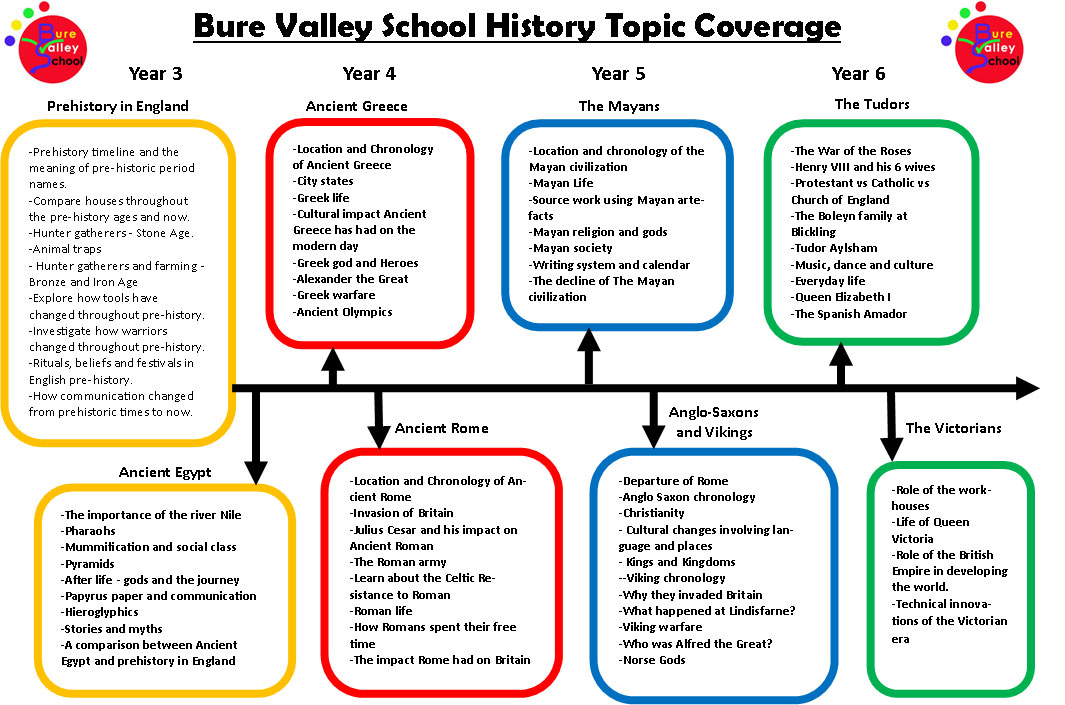
In lessons teachers use formative assessment to identify areas that children will need practice in following lessons in a particular unit of work. At the end of each unit of work, teachers assess children’s skills and knowledge of the unit to identify children working towards the expected level, at the expected level or those children working above the expected standard. These assessments identify areas that children will need to continue to develop or particular areas that the class will need further support.
The subject leader will monitor the impact in a variety of ways, including looking at children’s work, learning walks, discussions with children (pupil voice) and monitoring assessment.
A successful approach to history will include:
● Children are engaged with, enjoy and are enthusiastic about history in our school;
● There is a clear progression in skills in use of source materials and discussion across the history curriculum as children move through the school;
● Children’s work reflects our curriculum covering all the history units we teach;
● Children are ready for their next steps as they move on to high school;
● Teachers are supported by having the opportunity to work together in planning teams to share ideas and resources;
● Children across the school have the opportunity to take part in a history focused school trip that enriches learning.
Useful Links
Links to Reading
• Sources
• Recount texts
• Information texts
• Artefacts
Core Knowledge
Within each history unit, we outline:
- the objectives we want pupils to meet
- new learning and learning to be revisited
- the core knowledge we want pupils to retain and apply
- the vocabulary we want pupils to know and use correctly
We support this through a range of reflection and retrieval (R&R) activities that teachers can apply at their discretion:
- R&R Do Now’s – last year, last term, last unit, last week, last lesson
- History quizzes and quiz questions
- Reflective Learning Questions: exit ticket, multiple choice, can you still…, etc.
- Knowledge Flashcards
- Mind Maps
- Presentations – Speak Like a Historian
- Write a ‘Power Paragraph’ about what you know
- Recall Bingo
- Challenge Grids
- Home learning links & resources
- Lesson recaps/revisits
- Workshops and trips
At BVS we aim to ensure Design and Technology is an inspiring, rigorous and practical subject where pupils use creativity and imagination. We endeavour to design and make products that solve real and relevant problems within a variety of contexts, considering their own and others’ needs, wants and values. Children across the school acquire a broad range of subject knowledge and use cross-curricular skills from mathematics, science, computing and art to develop their engineering and DT skills. Pupils learn how to take risks, becoming resourceful; innovative, enterprising and capable citizens. Through the evaluation of past and present design and technology; they develop a critical understanding of its impact on daily life and the wider world.
When designing and making, pupils should be taught to:
Design
● use research and develop design criteria to inform the design of innovative, functional, appealing products that are fit for purpose, aimed at particular individuals or groups
● generate, develop, model and communicate their ideas through discussion, annotated sketches, cross-sectional and exploded diagrams, prototypes, pattern pieces and computer-aided design
Make
● select from and use a wider range of tools and equipment to perform practical tasks [for example, cutting, shaping, joining and finishing], accurately
● select from and use a wider range of materials and components, including construction materials, textiles and ingredients, according to their functional properties and aesthetic qualities
Evaluate
● investigate and analyse a range of existing products
● evaluate their ideas and products against their own design criteria and consider the views of others to improve their work
● understand how key events and individuals in design and technology have helped shape the world
Technical knowledge
● apply their understanding of how to strengthen, stiffen and reinforce more complex structures
● understand and use mechanical systems in their products [for example, gears, pulleys, cams, levers and linkages]
● understand and use electrical systems in their products [for example, series circuits incorporating switches, bulbs, buzzers and motors]
● apply their understanding of computing to program, monitor and control their products.
Cooking and Nutrition:
● understand and apply the principles of a healthy and varied diet
● prepare and cook a variety of predominantly savoury dishes using a range of cooking techniques
● understand seasonality, and know where and how a variety of ingredients are grown, reared, caught and processed.
The school has chosen to use the Design Technology Associations (DATA) Projects on a Page scheme of work. To help us implement the National Curriculum in an imaginative way. The scheme is based on the principles of effective teaching and learning in D&T and is a valuable resource that has been put together by experts in the field.
D&T is often one of a child’s favourite subjects. Children like making decisions for themselves and doing practical work. They love creating products they can see, touch – and even taste – for themselves. They feel proud to have done so. We feel that D&T should bring learning to life and that it is a motivating context for literacy, mathematics, science, art, PSHE and ICT
Core Threads
DT: Compare & Evaluate, Technical Knowledge, Safety
Our Design and Technology curriculum has been designed to identify and teach the key skills, knowledge and understanding required in the subject. Teachers have the freedom to block or to teach a unit across a term to best fit timetable and links to other areas of the curriculum.
Six D&T principles, that are the elements suggested by the D&T Association, should be in place in teachers’ planning in order to ensure that children’s learning is genuinely design and technological in nature are:
User
Pupils should have a clear idea of who they are designing and making products for, considering their needs, wants, values, interests and preferences. The intended users could be themselves or others, an imaginary or story-based character, a client, a consumer or a specific target group.
Purpose
Pupils should be able to clearly communicate the purpose of the products they are designing and making. Each product they create should be designed to perform one or more defined tasks. Pupils’ products should be evaluated through use.
Functionality
Pupils should design and make products that work/function effectively in order to fulfil users’ needs, wants and purposes. In D&T, it is insufficient for children to design and make products which are purely aesthetic.
Design Decisions
Pupils need opportunities to make their own design decisions. Making design decisions allows pupils to demonstrate their creative, technical and practical expertise, and use learning from other subjects. When making design decisions pupils decide on the form their product will take, how their product will work, what task or tasks it will perform and who the product will be for.
Innovation
When designing and making, pupils need some scope to be original with their thinking. Projects that encourage innovation lead to a range of design ideas and products being developed and are characterised by engaging open-ended starting points for learning.
Authenticity
Pupils should design and make products that are believable, real and meaningful to themselves and others.
| Year/Term | Unit | Product | User | Purpose | Links |
| 3/Aut | Animal traps | Insect trap | Stone Age Person | Scaled down animal trap | Science, history |
| 3/Spr | Food – healthy & varied diet | Teacher choice | Consumer | Health, profit, taste | Science (nutrition) |
| 3/Sum | Textiles – 2D shape to 3D product | Applique class blanket | Calm corner users | Blanket for calming security | English (reading) – Y2 transition |
| Year/Term | Unit | Product | User | Purpose | Links |
| 4/Aut | Mechanical systems – levers & linkages | Moving Christmas cards | Christmas card consumers | Create fun & movement in a card | Science |
| 4/Spr | Structures – shell structures | ||||
| 4/Sum | Electrical Systems – programme & control (Crumbles) | Night light | Young child | To soothe, comfort & amuse | Science – habitats |
| Year/Term | Unit | Product | User | Purpose | Links |
| 5/Aut | Food – culture & seasonality | Smoothie or soup project | Consumer | Create a tasty and easy to consume healthy product | PSHE – money * budgeting |
| 5/Spr | Mechanical systems – gears (including levers) | Lego toy | Child | Create a toy which is functional | Science – forces |
| 5/Sum | Electrical systems – monitoring & controlling (crumble pulleys) | Working model of a windmill | Teacher – teaching aid to model & support teaching | Create a working model.Learn about wind turbines | Geography – renewable energy |
| Year/Term | Unit | Product | User | Purpose | Links |
| 6/Aut | Electrical systems – complex switches & circuits | Light switch | Science – circuits | ||
| 6/Aut | Structures – frames | Skate ramp | Child | Ramp for Tec Decks – modelled on real life skate ramps | |
| 6/Sum | Textiles – combining different fabric shapes | Phone pouch | High school student | Hold and protect phone or other essentials | Y6/7 transition |
Our Design and Technology curriculum enables and encourages our children to become critical thinkers and problem solvers. Through Design and Technology our children learn to take risks, become resourceful and innovative. Children at Bure Valley learn to be passionate and excited by the designing and making of products including working with, preparing and tasting food.
Learning is assessed through the analysis of the children’s ability to design, make, evaluate and improve their own work.
The impact of Design Technology is measured in a variety of ways including pupil voice, observations, book looks, photos and the products they design and make.
We complete an annual self-review to monitor the impact of our actions in Design Technology. This helps to address the need of the subject.
Teachers assess progress using the Design Technology Association’s progression framework.
Useful Links
Links to Reading
• Instructions
• Product descriptions
• Product research
• Marketing materials
Core Knowledge
Within each DT unit, we outline:
- the objectives we want pupils to meet
- new learning and learning to be revisited
- the core knowledge we want pupils to retain and apply
- the vocabulary we want pupils to know and use correctly
Within our curriculum, the same six principles of DT feature in every unit. Pupils get lots of opportunities to revisit concepts and repeat the cycle of design, make and evaluate. This supports knowledge retention and skill development.
We use a range of reflection and retrieval (R&R) activities (that teachers can apply at their discretion) to support this process:
- R&R Do Now’s – last year, last term, last unit, last week, last lesson
- DT quizzes
- Reflective Learning Questions: exit ticket, multiple choice, can you still…, etc.
- Knowledge Flashcards
- Mind Maps
- Presentations – Speak Like an Expert
- Write a ‘Power Paragraph’ about what you know
- DT Recall Bingo
- Home learning links & resources
- Lesson recaps/revisits
The National Curriculum for music aims to ensure that all pupils:
● Perform, listen to, review and evaluate music
● Be taught to sing, create and compose music
● Understand and explore how music is created, produced and communicated
At Bure Valley School, we want our children to gain a firm understanding of what music is. This is through listening, singing, playing, evaluating, analysing and composing across a wide variety of historical periods, styles, traditions and musical genres. We are committed to ensuring children understand the value and importance of music in the wider community and for their own wellbeing.
Our unique music curriculum is research based and designed to take pupils on a journey in music, which we feel, exceeds the expectations of the National Curriculum.
We provide the opportunity for every child in the school to receive quality instrumental tuition for the entire time they are at the school: African drums in Year 3 with a focus on rhythm; recorders and glockenspiels in Year 4 introducing tune and notation, and finishing with a choice of orchestral instrument for Years 5 & 6 which combines the earlier learning with larger ensemble playing and performance.
In each of these stages, children are given the opportunity to compose or create music with their instrument – be that from creation of rhythms and beats, to responding to a stimulus e.g. creating an orchestra Storm in response to Benjamin Britten’s piece of the same name. Through our year-on-year phased approach to music tuition, we are able to clearly demonstrate progression for every pupil in the time they are at Bure Valley School.
Whole Class Ensemble Teaching is further supplemented by singing assemblies and class teacher led listening and appraising – with a focus on a wide range of music and particularly topical themes e.g. Jubilee, sporting events, popular music, themes etc.
The pupils at Bure Valley School have extra-curricular opportunities available as well including a successful and popular school choir, a local ensemble hosted by the school, and other trips and opportunities. 1-2-1 tuition is also available for those children who wish to further their instrumental learning. We take part in community events where possible. In recent years Bure Valley School pupils have sung for local groups and took part in our Summer concert, where the whole school performed a piece of music as a 240 piece ensemble. Additionally, the school choir took part in the Young Voices 2022 concerts in London.
Our music curriculum and teaching is supported through partnership with Norfolk Music Hub who provide some of the teaching expertise and the orchestral instruments for the children to use. This is very much a collaborative approach with Norfolk Music Hub teachers and Bure Valley School based teachers, working together to deliver high quality lessons and opportunities. The music curriculum at Bure Valley School has been crafted over the last decade and is research based. In 2015, a Masters level research project sought to find an effective solution to teaching music history within the whole class setup, the results of which still inform our practise. More recently, we have opened the music teaching at Bure Valley School to scrutiny through another Masters level project looking into the effectiveness of whole class ensemble teaching.
Our most recent Ofsted report (2019) also looked closely at music teaching at Bure Valley School and concluded that:
‘Pupils can talk confidently about what they should know in…music. Music and sports are real strengths of the school. In music, every pupil learns an instrument for all four years of their time at school. The quality of education is effective in music, and pupils reach high levels of performance.’
Core Threads
Music: Music Notation, Musical Appreciation, Instruments, Singing
We work in partnership with the Music Service to promote and offer high quality music education. This can be through:
- Individual instrumental and vocal teaching;
- Weekly whole class lessons;
- Singing assembly/choir;
- Cluster ensemble
Tuition can take place anytime during the extended school day.
We work with the Music Service to provide a musical pathway for all our young players for every stage of learning and host the Aylsham Cluster Ensemble.
Ensembles are an important part of learning to play a musical instrument and are often the most enjoyable and socially rewarding part of the process.
At Bure Valley School children are provided with opportunities beyond the National Curriculum to further and support their understanding. These include having visitors with musical talent, and school productions. They also enjoy a variety of opportunities to sing in the community.
We measure the impact of music in many ways including video recordings, pupil voice and observations.
Across the school, the impact of music can be seen in the children’s enjoyment and enthusiasm when singing in whole school celebrations, their interest and response when listening to different styles of music and their confidence when appraising, performing or composing music.
Useful Links
Links to Reading
- Musical vocabulary
- Talking and evaluation
- Song words and lyrics
- Musical articles
Core Knowledge
Within each music unit, we outline:
- the objectives we want pupils to meet
- new learning and learning to be revisited
- the core knowledge we want pupils to retain and apply
- the vocabulary we want pupils to know and use correctly
Within our music curriculum, pupils get to revisit and build on their understanding of musical genres, music notation, musical appreciation and singing.
We support the retention of knowledge, promote skill progression and use of technical vocabulary through a range of reflection and retrieval (R&R) activities that teachers can apply at their discretion in music:
- R&R Do Now’s – last year, last term, last unit, last week, last lesson
- Music Quizzes
- Reflective Learning Questions
- Knowledge Flashcards
- Mind Maps
- Presentations – Speak Like an Expert & Play Like a Musician
- Recordings – Performance Analysis
- Rehearsal and Performances
- Recall Bingo
- Challenge Grids – Can You…
- Home learning links & resources
- Lesson recaps/revisits
At Bure Valley School, art is a vital part of our curriculum providing a means of expression for all our children, regardless of their competence in verbal and written communication.
In addition to art being a practical subject stimulating creativity and imagination through the use of a wide range of materials, we believe it is very effective as a cross-curricular link, adding to our children’s experiences and depth of understanding in other areas of their learning; from creating their own topic related artwork, zines and artefacts to recording findings and learning from school trips or school visitors.
We incorporated the use of sketchbooks into our art curriculum before they were introduced into the KS2 National Curriculum believing them to be central to children’s creativity as a space where they can plan, develop and learn with free expression.
Our school timetable ensures all our children have creative opportunities for art every week in all classes.
The national curriculum for art and design aims to ensure that all pupils:
● Produce creative work, exploring their ideas and recording their experiences
● Become proficient in drawing, painting, sculpture and other art, craft and design techniques
● Evaluate and analyse creative works using the language of art, craft and design
● Know about great artists, craft makers and designers, and understand the historical and cultural development of their art forms.
National Curriculum Attainment targets for Bure Valley School:
● By the end of Y6, pupils are expected to know, apply and understand the matters, skills and processes specified in the KS2 programme of study –
● Pupils should be taught to develop their techniques, including their control and their use of materials, with creativity, experimentation and an increasing awareness of different kinds of art, craft and design.
Pupils should be taught:
● To create sketch books to record their observations and use them to review and revisit ideas
● To improve their mastery of art and design techniques, including drawing, painting and sculpture with a range of materials [for example, pencil, charcoal, paint, clay]
● About great artists, architects and designers in history.
We understand that Art and Design stimulates creativity and imagination. It provides visual, tactile and sensory experiences and a special way of responding and understanding the world. It enables children of all abilities to communicate what they see, feel and think through the use of colour, texture, form, pattern and different materials and processes.
At Bure Valley School we encourage children to explore ideas through the work of a range of artists. Through learning about the roles and functions with art, the children can explore the impact it has had on contemporary life and that of different times and cultures. The appreciation and enjoyment of the visual arts enriches all of our lives.
Core Threads
Art: Knowledge of Artists, Artistic Techniques, Artistic Appreciation
At Bure Valley School the children are taught a block of work each half term, linking to their topic where possible. The progression of skills are mapped out across the year groups so that the children continually build on previous learning. Our curriculum provides children with the opportunities to develop their skills using a variety of media and materials. Children study a range of works by famous artists to develop a knowledge of styles, this also provides cross curricular links.
Each child has their own individual sketch book which follows them through the school and shows their progression. Children’s artwork is displayed around school to motivate and inspire others and to celebrate the pupils’ work. Every year, the children have the opportunity to produce artwork to display in our end of year exhibitions.
At Bure Valley School the impact of art is measured in many ways including building a portfolio of examples of artwork from across the school, pupil voice, observations and sketch books.
Across the school, the impact of art can be seen in the children’s artwork which is displayed, the progression of skills shown in sketchbook work and the children’s final piece of artwork and their knowledge of artists and their styles.
The children are also given opportunities and are encouraged to be reflective about their own and other’s work, with their responses showing their understanding and expected vocabulary.
Useful Links
Links to Reading
- Artists study
- Vocabulary usage and definition
- Research extracts
- Instructional pieces
Core Knowledge
Within each art unit, we outline:
- the objectives we want pupils to meet
- new learning and learning to be revisited
- the core knowledge we want pupils to retain and apply
- the vocabulary we want pupils to know and use correctly
Our art curriculum builds progressively and allows for pupils to revisit learning and prior knowledge. We support this further through a range of reflection and retrieval (R&R) activities that teachers can apply at their discretion in art:
- R&R Do Now’s – last year, last term, last unit, last week, last lesson
- Art Quizzes
- Peer Galleries (Critiquing)
- Reflective Learning Questions: exit ticket, multiple choice, can you still…, etc.
- Knowledge Flashcards
- Mind Maps
- Presentations – Speak Like an Expert Artist/Art Historian
- Demonstrate your understanding of… this artist… this technique…
- Use what you know…
- What do you recall about…
- Challenge Grids
- Home learning links & resources
- Lesson recaps/revisits
- Trips and visits
Religious education is taught as a basis for tolerance and to enable children to investigate, wonder and reflect upon fundamental questions of life. For example, the meaning of life and the existence of a divine spirit. We enable children to develop a sound knowledge, not only of Christianity but also of other world religions and world views. Children reflect on what it means to have a faith and to develop their own spiritual knowledge and understanding. We help the children learn from religions and worldviews as well as about religions and worldviews.
The objectives of teaching religious education in our school are to ensure that all pupils:
- develop an awareness of spiritual and moral issues arising in their lives;
- develop knowledge and understanding of Christianity, other world religions and value systems found in Britain;
- develop an understanding of what it means to be committed to a religious tradition;
- be able to reflect on their own experiences and develop a personal response to life’s key questions.
- develop understanding of religious traditions and cultural differences in UK today;
- develop investigative/research skills, making reasoned judgements about religious issues;
- have respect for other people’s views, and celebrate the diversity in society.
There is no National Curriculum for RE. Instead each UK region has created their own ‘Statutory Agreed Syllabus’. Norfolk’s Agreed Syllabus 2021 has a focus on RE as multi-disciplinary. RE is rooted in three key disciplines or disciplinary fields. These are theology, philosophy and the human/social sciences. In the Norfolk Agreed Syllabus they are re-contextualised for the school context in the following ways:
Theology
We have called this thinking through believing. It is about asking questions that believers would ask. It requires pupils to think like theologians, or to look at concepts through a theological lens. Pupils will explore questions and answers that arise from inside religions and worldviews.
Philosophy
We have called this thinking through thinking. It is about asking questions that thinkers would ask. It requires pupils to think like philosophers, or to look at concepts through a philosophical lens. Pupils will explore questions and answers raised through considering the nature of knowledge, existence and morality.
Human/Social Sciences
We have called this thinking through living. It is about asking questions that people who study lived reality or phenomena would ask. It requires pupils to think like human and social scientists, or to look at concepts through a human/social science lens. Pupils will explore questions and answers raised in relation to the impact of religions and worldviews on people and their lives.
Effective RE will balance these three disciplinary lenses in order for pupils to become more religiously literate.
Which religions and worldviews do we need to study in KS2?
Pupils complete five enquiries throughout the year.
Core Threads: Celebrations, Respect, Prominent Figures
We follow an ‘enquiry-led’ approach for RE. By completing five enquiries each year, pupils cover the required areas of study.
This approach has five steps required to answer a key enquiry question. See long-term plans for all the key enquiry questions each year group has been allocated.
Engage – Step 1 – the key enquiry question, such as ‘Why is the Quran important to Muslims?’ should be introduced by engaging learners through a stimulus and engaging activity that introduces the general topic – such as creating an symmetrical Islamic pattern used on the cover of a Quran, using paper shapes. 1 hour
This stage needs to be relevant to the learners own experiences. Allow all learners the opportunity to explore the concept through a range of activities. This could include artefacts, music, a story, a video clip, a dilemma etc.
Enquire – Step 2 – pupils create sub-questions based on the overall key enquiry question. 1 hour
Teachers may wish to suggest sub-questions; however, this stage is about co-construction. Talk about what will happen in the express stage (what the outcome will be). Will the questions lead to better understanding? Are they at an appropriate level – use assessment documents to help you judge this?
Will these questions help to answer our key question? What do we already know? What do we want to know? How could we find the answer? Why is this important? How will it affect your life? This enquiry step may take place as a whole class.
Explore – Step 3 – pupils explore the concept (see plan) through the process of enquiry using appropriate content. Two hours
Teachers may wish to use direct teaching lessons for some content. Ensure everything you study links back to the questions. Have you come any closer to answering your question? Here you might use texts, video clips, research, quotes from religious text, stories etc.
Evaluate – Step 4 – pupils respond & analyse and evaluate understanding of the concept. 1 hour
Evaluate what you have found out, can you offer any alternatives? Opportunity for robust and challenging discussion. Teachers may pose questions. Use of dialogue and debate, agreeing to disagree, further questions. What can we learn from this religion?
Have we answered our questions? What do we understand about the concept? How far have we answered the key question? Does it matter if we have conflicting views? Are there questions that still need resolving? This evaluation step may take place as a whole class.
Express – Step 5 – pupils express knowledge and understanding they have gained to answer key questions (a final piece of work). One hour.
Draw together what they have learned. Use different approaches at this stage. Could involve presentations, webpage, debate, leaflet, written work, art, drama, music etc.
For example, an annotated stained glass window to express learning about Easter, or a matching pair’s game to show understanding of key Hindu ideas, or a board game showing how to reach Buddhism enlightenment or a heart shaped poster showing what Christians can learn from the Bible.
Pupils’ progress is assessed in relation to the purpose and aims of the subject. Therefore, this primarily concerns how well pupils are able to hold balanced and well-informed conversations about religion and worldviews. In other words, are pupils becoming more religiously literate? Attainment and progress are therefore linked to the multi-disciplinary approach to RE advocated throughout the agreed Norfolk syllabus.
Teachers are encouraged to use the non-statutory age-related expectations as a starting point for planning alongside the suggested core questions for our key stage. This ensures that expected outcomes are at an appropriate standard and that the learning journey for each enquiry is clear. The non-statutory age-related expectations ensure that the RE provision is balanced and that pupils become more religiously literate through their time in school.
Appendix 2: Non- Statutory age-related expectations showing examples for Key Stage 1-325
It is a statutory requirement for schools to provide, at least annually, a written report to parents on their child’s progress in RE.
Useful Links
Links to Reading
- Religious stories/fables
- Religious texts
- Information texts
- Subject specific vocabulary
- Discussion & debate
Core Knowledge
Within each RE unit, we outline:
- the objectives we want pupils to meet
- new learning and learning to be revisited
- the core knowledge we want pupils to retain and apply
- the vocabulary we want pupils to know and use correctly
We support this through a range of reflection and retrieval (R&R) activities that teachers can apply at their discretion in RE:
- R&R Do Now’s – last year, last term, last unit, last week, last lesson
- Quizzes
- Reflective Learning Questions: exit ticket, multiple choice, can you still…, etc.
- Knowledge Flashcards
- Mind Maps
- Presentations – Speak Like an Expert
- Write a ‘Power Paragraph’ about what you know
- Recall Bingo
- Challenge Grids
- Home learning links & resources
- Lesson recaps/revisits
The Physical Education curriculum at BVS aims to deliver a high-quality PE experience which inspires all pupils to succeed and excel in competitive sport and other physically-demanding activities. It provides opportunities for pupils to become physically confident in a way that supports their health and fitness. Opportunities to compete in sport and other activities build character and help to embed values such as fairness and respect. The school uses a variety of teaching and learning styles in lessons including practical lessons, with drama and exploration. Children also have the opportunity to use an extensive range of materials and resources. The school uses the ‘Real PE’ scheme of work, which is delivered by each class teacher once a week to their class. Real PE targets the skills our pupils need in order to succeed in life both at and beyond BVS. These fundamental skills include: personal, social, cognitive, creative, physical, and health & fitness. We also offer a second lesson each week for pupils that is delivered by a PE specialist. These sessions have more of a sports focus where pupils will have an opportunity to experience a wide range of sports, from invasion games, to athletics, to gymnastics and dance. We hope this will give our pupils a desire to take up these sporting activities outside of school. Wherever possible of course, trips, competitions and visitors will be used to enhance the Physical Education curriculum.
The National Curriculum for Physical Education aims to ensure that all pupils:
● develop competence to excel in a broad range of physical activities
● are physically active for sustained periods of time
● engage in competitive sports and activities lead healthy, active lives.
Pupils should arrive in KS2 being able to:
● master basic movements including running, jumping, throwing and catching, as well as developing balance, agility and coordination, and begin to apply these in a range of activities
● participate in team games, developing simple tactics for attacking and defending
● perform dances using simple movement patterns.
Pupils should leave KS2 6 being able to:
● use running, jumping, throwing and catching in isolation and in combination
● play competitive games, modified where appropriate [for example, badminton, basketball, cricket, football, hockey, netball, rounders and tennis], and apply basic principles suitable for attacking and defending
● develop flexibility, strength, technique, control and balance [for example, through athletics and gymnastics]
● perform dances using a range of movement patterns
● take part in outdoor and adventurous activity challenges both individually and within a team
● compare their performances with previous ones and demonstrate improvement to achieve their personal best.
● swim competently, confidently and proficiently over a distance of at least 25 metres.
● use a range of strokes effectively [for example, front crawl, backstroke and breaststroke].
● perform safe self-rescue in different water-based situations.
Physical Education is concerned with the promotion of positive attitudes towards physical activity and well-being. At Bure Valley we use the real PE scheme of work alongside our specialist provision.
Real PE is a unique, child centred approach that transforms how we teach PE to include, challenge and support EVERY child.
Real PE supports us with:
● Training and support – through training we can develop the confidence of staff and improve the skills they need to deliver an outstanding PE curriculum. Training also includes whole school initiatives, playground supervisors and subject leadership.
● Whole school curriculum & scheme of work – provide us with a flexible and progressive curriculum, that has clear Intent and progression of skills aligned to the National Curriculum. Through our real PE platform, we receive high quality, interactive PE Schemes of Work to support planning and lesson delivery. These come with video support, music and other supporting resources.
● Teaching and learning – real PE helps us to align our Implementation with Intent through a simple teaching and learning framework which outlines the essential teaching habits required to develop the positive behaviours, skills and knowledge of our pupils. Through this approach, EVERY child should feel valued, included, challenged and supported in their learning.
● Assessment and impact – the real PE Assessment Wheel supports us to quickly assess pupil progress, store evidence, report and inform planning. An impact report celebrates improvements in: staff confidence, pupil engagement, pupil progress and the broader impact of real PE across the school.
● real PE at home – helps us to change the culture around home learning in PE for every family. Real PE at home consolidates, reinforces and accelerates learning, while forging a stronger link between school and home.
● real PE membership – gives us ongoing support to make PE successful at BVS. We intend to help all children make better progress, have confident teachers and whole school impact. real PE membership gives us access to a whole range of benefits, including being a part of a community of 2,000+ other real PE member schools.
The values-led approach of real PE is very different to traditional PE approaches and allows every child and every member of staff to flourish, regardless of their own ability, and they demonstrated everything in action. The teaching resources and assessment materials will drastically cut workload and ensure we are delivering very high quality PE across school.
Core Threads
PE: Practice and Performance, Inclusion, Tactics
Staff and children are supported by realPE to facilitate holistic PE teaching and learning alongside a fortnightly afternoon of specialist PE provision in which children develop their physical and fundamental games skills. Pupils’ understanding of game scenarios and tactics builds progressively alongside their physical and technical skills.
Year Three
| Real PE | |||||
| Autumn 1 | Autumn 2 | Spring 1 | Spring 2 | Summer 1 | Summer 2 |
| Personal | Social | Cognitive | Creative | Physical | Health & Fitness |
| Specialist PE | |||||
| Autumn 1 | Autumn 2 | Spring 1 | Spring 2 | Summer 1 | Summer 2 |
| Cross CountryTennis | Dance | SwimmingTag Rugby | SwimmingTag Rugby | Athletics | Tri-Golf |
Year Four
| Real PE | |||||
| Autumn 1 | Autumn 2 | Spring 1 | Spring 2 | Summer 1 | Summer 2 |
| Personal | Social | Cognitive | Creative | Physical | Health & Fitness |
| Specialist PE | |||||
| Autumn 1 | Autumn 2 | Spring 1 | Spring 2 | Summer 1 | Summer 2 |
| SwimmingSports Hall Athletics | SwimmingSports Hall Athletics | Gymnastics | Tennis | Tri-Golf | Netball |
Year 5
| Real PE | |||||
| Autumn 1 | Autumn 2 | Spring 1 | Spring 2 | Summer 1 | Summer 2 |
| Cognitive | Creative | Social | Physical | Health & Fitness | Personal |
| Specialist PE | |||||
| Autumn 1 | Autumn 2 | Spring 1 | Spring 2 | Summer 1 | Summer 2 |
| Tag-Rugby | Dance | Dodgeball | Netball | Cricket(plus sub 25m swimming) | Athletics |
Year 6
| Real PE | |||||
| Autumn 1 | Autumn 2 | Spring 1 | Spring 2 | Summer 1 | Summer 2 |
| Cognitive | Creative | Social | Physical | Health & Fitness | Personal |
| Specialist PE | |||||
| Autumn 1 | Autumn 2 | Spring 1 | Spring 2 | Summer 1 | Summer 2 |
| Tag-Rugby | Sports Hall Athletics | Gymnastics | Netball | Cricket | Invasion Games |
At BVS the impact of the PE Curriculum is assessed termly against the real PE progression framework and against unit objectives. Due to the holistic nature of our curriculum, children are assessed against a whole range of skills, not simply physical ones. Assessment informs planning.
When monitoring the impact of PE at Bure Valley, we believe impactful PE is:
● High levels of engagement and enjoyment
● Greater confidence
● Progress in physical and technical skills
● Progress in tactical awareness and understanding
● Positive behaviours for learning and for coaching and supporting others
● Increase in the confidence and knowledge of staff
● Broad range of activities and opportunities across the extended school day
● Increase participation in competitive sport, with strong community links and pathways
Useful Links
Links to Reading
- Rules/laws of games
- Equipment lists
- PE specific vocabulary
- Evaluation/analysis tasks
Core Knowledge
Within each PE unit, we outline:
- the objectives we want pupils to meet
- new learning and learning to be revisited
- the core knowledge we want pupils to retain and apply
- the vocabulary we want pupils to know and use correctly
Our PE curriculum is designed to give pupils opportunities to revisit concepts, disciplinary skills and knowledge. The themes of performance, practice, evaluation and tactics are revisited.
We support knowledge retention through a range of reflection and retrieval (R&R) activities that teachers can apply at their discretion in PE:
- R&R Do Now’s – last year, last term, last unit, last week, last lesson
- PE Quizzes
- Reflective Learning Questions: exit ticket, multiple choice, can you still…, etc.
- Knowledge Flashcards
- Mind Maps
- Presentations – Speak Like an Expert
- Write a ‘Power Paragraph’ about what you know
- Show me how to…
- Tell me about…
- Recall Bingo
- Challenge Grids
- Home learning links & resources
- Lesson recaps/revisits
- Games, tournaments, events
https://www.burevalleyschool.org.uk/wp-content/uploads/2017/01/Core-Knowledge-PE-Yr3-6.pdf
Our Life Skills curriculum lays out the specific objectives (posed as questions) that the children will be taught during the 4 years that they are at BVS. The curriculum is divided into 6 areas: Relationships; Sex Education and my body; Personal Development; Healthy Living; Living in the Wider World (including, but not exclusively, citizenship, the environment and democracy) and Financial Literacy. The statutory element of Relationship and Sex Education is taught within PSHE.
The curriculum is spiral, with the children revisiting objectives each year. For example, keeping safe online is taught in age-appropriate lessons to every class, every year.
Lessons are planned collaboratively by year group teachers, and may include a variety of approaches depending on the cohort and the nature of the lesson content. When written work is completed, it is done so in an exercise book, or learning may be presented in another form, such as group posters, drama and role play, discussion of suggested scenarios, art work etc.
Our aspiration is to have 10×1 hour lessons each term from the planned curriculum, but also allow 2 lessons per term for responsive lessons that react to local, national or international events that we feel need to have time devoted to them. A good example of this was the development of the war in Ukraine this year, which we felt needed to be taught to the children and to allow the children to discuss and process the information and images that they were receiving through different forms of media.
The nature of the content of this Life Skills curriculum means that all lessons are planned to be accessed by all pupils, in a mixed attainment environment.
We have 1 exception to this. In Y5 and Y6, one lesson is planned as part of the Sex Education curriculum where boys and girls are separated. This is to allow a Q&A session in a safe environment and to allow boys and girls to speak freely about gender-specific issues. We review this annually, and will be particularly conscious of this, if we have any pupils who identify as trans.
We do not follow a specific scheme, with the exception of our RSE lessons, when we use the RSE Solutions resources published by Education Solutions. A variety of resources, both printed and online, are promoted to teachers to use in their lesson planning, including resources provided by the PSHE Association of which we are a member.
The objectives of our PSHE curriculum are published, each term, to parents through year group newsletters. Parents are also informed when their child’s class is about to have some specific RSE lessons. Resources are made available to parents who wish to view them.
Core Threads
PSHE: Relationships, Living in the Wider World, Health and Wellbeing
Life Skills is not a curriculum area that requires a specific knowledge or skills base – although taught well and in a coherent manner, it does lead to children who are resilient and able to respond appropriately to challenging situations.
Children will know who can provide support and how to seek that support. Children will be articulate about mental and physical well-being and feel empowered to report if they are abused in any way by peers or others. PSHE & RSE teaching will ensure that children are aware of the physical and emotional changes that will happen to them during adolescence and how to seek support.
We aim to teach Life Skills (PSHE) lessons throughout the year. We may choose to teach objectives out of the above sequence in order to respond to class, school, local and national events. Several objectives may be covered by one session, or several sessions may be taken to cover one objective. We may also choose to teach lessons not listed above in response to need. Objectives may also be taught to complement learning in other curriculum areas e.g.) maths (finance) geography (environmental responsibility) science (naming parts of the body).
At BVS we monitor the effectiveness of teaching and the impact it has on learning and understanding. Through book looks, pupil interviews and lesson drop-ins we can see if pupils are learning and remembering the planned curriculum.
Useful Links
Links to Reading
- Articles
- Subject specific vocabulary
- News
- Information texts
- Stories
- Books about PSHE issues
Core Knowledge
Our PSHE curriculum is spiral by design, this enables pupils to revisit core learning.
We support knowledge retention through a range of reflection and retrieval (R&R) activities that teachers can apply at their discretion in PSHE:
- R&R Do Now’s – last year, last term, last unit, last week, last lesson
- Quizzes
- Reflective Learning Questions: exit ticket, multiple choice, can you still…, etc.
- Knowledge Flashcards
- Mind Maps
- Presentations – Speak Like an Expert
- Write a ‘Power Paragraph’ about what you know
- Show me how to…
- Tell me about…
- Recall Bingo
- Challenge Grids
- Home learning links & resources
- Lesson recaps/revisits
- Workshops, trips, visits and guest speakers
- Assemblies
RSHE is learning about the emotional, social and physical aspects of growing up, relationships, sex, human sexuality and sexual health in an age and stage appropriate manner.
It is our intent that we will equip children and young people with accurate information, positive values and the skills to enjoy healthy, safe and positive relationships, within which they value their sexuality and take responsibility for their health and wellbeing both now and in the future.
We recognise the importance of RSHE in preparing children and young people to live safe, fulfilled and healthy lives. The objective of RSHE is to support children and young people through a journey of physical, emotional and moral development, through the teaching of essential knowledge, skills and values within the framework of the law, relevant provisions of the Equality Act, 2010 and through the teaching of relationships and sex.
Under the Children and Social Work Act 2017, the government committed to making relationships education (primary) and relationships and sex education (secondary) statutory in all schools, including LA maintained schools, academies, free schools and independent schools. All schools are required to have a Relationships and Sex Education Policy.
At Bure Valley School our RSE curriculum objectives are taught as part of our wider, PSHE curriculum. Lessons are predominantly mixed gender and taught by class teachers. However, on occasion, we may invite visitors in and may teach single-gender lessons. Lessons are always age-appropriate and collaboratively planned with other year group colleagues.
Within our RSE teaching, we aim:
● To deepen children’s understanding of good and not so good feelings and to extend children’s vocabulary to enable them to explain both the range and intensity of their feelings to others.
● To recognise what constitutes a positive, healthy relationship. To develop the skills to develop and maintain positive and healthy relationships.
● To realise the nature and consequences of discrimination, teasing, bullying and aggressive behaviours (including use of prejudice-based language including LGBT)
● To refresh knowledge of names for the external genitalia (including clitoris). How their bodies will change as they approach and move through puberty.
● To know that bacteria and viruses can affect their health and that following simple routines can reduce their spread.
● To know that differences and similarities between people arise from a number of factors, including sex and sexual orientation.
● To be able to judge what kind of physical contact is acceptable or unacceptable and how to respond.
● To know strategies for keeping physically and emotionally safe online, including social media, the responsible use of ICT and mobile phones.
● To know the importance of protecting personal information, including passwords, addresses and images.
● To understand the concept of ‘keeping something confidential or secret’, when we should or should not agree to see this and when it is right to ‘break a confidence’ or ‘share a secret’.
● To recognise that their increasing independence brings increased responsibility to keep themselves and others safe. To recognise when and how to ask for help using basic techniques.
● To know about people who are responsible for helping them stay healthy and safe, and ways that they can help these people.
● To know about human reproduction including conception (and that this can be prevented).
● To recognise how images in the media do not always reflect reality, and can affect how people feel about themselves.
We believe that effective RSE can make a significant contribution to the development of personal skills needed by pupils to establish and maintain relationships. RSE will ensure children and young people are encouraged to understand the importance of stable, loving relationships, respect, love, and care in line with our ethical and cooperative values. It also enables young people to make responsible and informed decisions about their health and wellbeing.
RSH will be approached through evidence-based, best practice principles to ensure the highest impact on improving pupil health, wellbeing, safeguarding and lifelong outcomes.
Core Threads
RSE: Relationships, Living in the Wider World, Health and Wellbeing
The majority of elements of the RSE curriculum are a statutory requirement to teach to meet the June 2019 Government RSE guidance and The Equalities Act, 2010.
RSE will be taught through a ‘spiral curriculum’. This approach means that pupils will gain knowledge, develop values and acquire skills gradually during their school years by re-visiting core themes to build on prior learning. RSE will support the school’s commitment to safeguard pupils through an age-appropriate curriculum that prepares them to live safely in the modern world.
Our intended RSE curriculum is detailed below, but may vary in response to emerging issues and to reflect the rapidly changing world in which our pupils are living and learning. If this is the case parent/carers will be provided with appropriate notice before the amended programme is delivered. Where possible the curriculum will be complemented by themed assemblies, topic days and cross curricular links.
We will be following ‘The Relationships and Sex Education (RSE) Solution’ Curriculum which has been developed by Educator Solutions. The children will have at least 6 lessons spread out over the course of the school year. Lessons will be taught in Year Groups and not classes so the material is age appropriate.
Pupils’ learning will be assessed at the end of every topic to ensure that pupils are making sufficient progress to build on prior teaching and learning and that teaching strategies and resources remain relevant and effective. Assessment activities will be implicit, forming part of a normal teaching activity to ensure that pupils do not feel under pressure. There will be self-assessment tasks throughout the programme that will confirm pupils understanding of the topics. The evaluation of teaching and learning assessments will be shared with pupils and parents as appropriate.
The quality of RSE teaching and learning will be monitored through RSE learning walks, team teaching and informal drop-ins conducted by subject leads and/or members of the senior leadership team. Governors will monitor the quality of provision, pupil progress and accessibility of the RSE provision. Specific governor responsibilities are in section 38 and 39 of the RSE Guidance. The observations and findings of which will be used to identify and inform future staff training and resource needs.
Useful Links
Links to Reading
- Articles
- Subject specific vocabulary
- News
- Information texts
- Stories
Core Knowledge
Our RSE curriculum enables pupils to revisit core learning.
We also support knowledge retention through a range of reflection and retrieval (R&R) activities that teachers can apply at their discretion in RSE:
- R&R Do Now’s – last year, last term, last unit, last week, last lesson
- Quizzes
- Reflective Learning Questions: exit ticket, multiple choice, can you still…, etc.
- Knowledge Flashcards
- Mind Maps
- Presentations – Speak Like an Expert
- Write a ‘Power Paragraph’ about what you know
- Show me how to…
- Tell me about…
- Recall Bingo
- Challenge Grids
- Home learning links & resources
- Lesson recaps/revisits
- Assemblies
- Guest speakers